• How Can We Help
    • FREE Business Health Check
    • Taxation Consulting
    • Accounting
    • Solo & Micro Business
    • Business Advisory
    • Medium Sized Businesses
    • SMSF
    • Single-Touch Payroll
  • Why Us
    • About Us
    • Testimonials
  • Xero
    • Why Xero
    • Free Xero Training
  • Client Tools
    • Xero Add-ons
    • Tax Facts
    • Links
  • Blog
  • Contact Us
  • Skip to primary navigation
  • Skip to content
  • Skip to footer

RA Business Advisors

  • 07 3367 0852
  • How Can We Help
    • FREE Business Health Check
    • Taxation Consulting
    • Accounting
    • Solo & Micro Business
    • Business Advisory
    • Medium Sized Businesses
    • SMSF
    • Single-Touch Payroll
  • Why Us
    • About Us
    • Testimonials
  • Xero
    • Why Xero
    • Free Xero Training
  • Client Tools
    • Xero Add-ons
    • Tax Facts
    • Links
  • Blog
  • Contact Us

Uncategorised

Beware of Tax Scams: A Guide for Australians

March 31, 2025 By raadmin

As tax season approaches, Australians need to be vigilant about the increase in tax scams. Cybercriminals are becoming more sophisticated, and it’s crucial to recognize and avoid these fraudulent activities. An article written by Martin Kraemer for Accountants Daily highlights some key points on what you need to know to protect yourself.

1. myGov Email Impersonation Scams

Beware of phishing scams that mimic ATO emails and myGov sign-in pages. These scams aim to steal your myGov credentials and are often disguised as legitimate ATO communications. Scammers cleverly create fake ATO emails containing links that encourage people to click on a link directing them to fake myGov sign-in pages designed to steal their usernames and passwords. Over the past six months, a staggering 75% of all email scams reported to the ATO involved a fake myGov login link. Stay cautious and verify any communication claiming to be from the ATO.
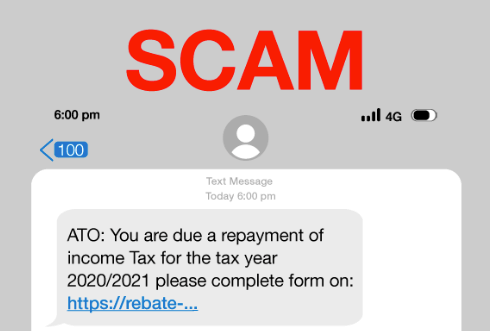
Scammers are also exploiting other digital channels such as SMS messaging to get individuals to click on fake myGov sign-in pages designed to steal their usernames and passwords. Scammers use different phrases to trick people into opening these links. Some examples are:
• You are due to receive an ATO Direct refund
• You have a new message in your myGov inbox – click here to view
• You need to update your details to allow your Tax return to be processed
• We need to verify your incoming tax deposit
• ATO refund failed due to incorrect BSB/account number
• Your income statement is ready, click on the link to view

2. ATO Social Media Impersonation Scams

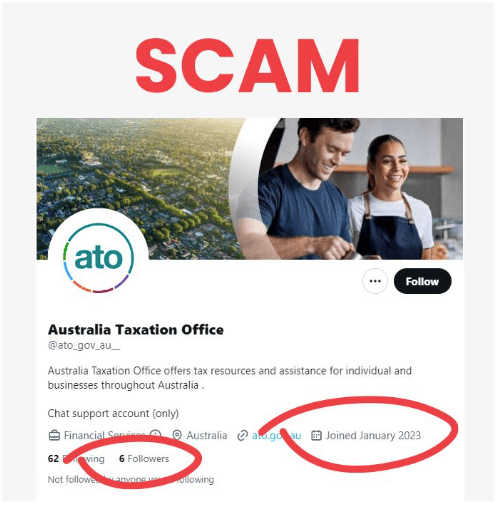
Scammers also target social media users by creating fake ATO accounts. These scams impersonate both the ATO itself and ATO employees. The intent is to get you to interact with the pages, send messages, and ask questions, ultimately tricking you into sharing personal information such as email addresses, phone numbers, and bank account details. Always look for the blue tick of authentication on official ATO accounts (Facebook, Twitter, and LinkedIn) and avoid engaging with suspicious accounts.
How to spot a fake:
• The ATO prioritises secure communication. It will never send email or social media links directing you to log in to myGov or other online services. Treat any such requests as scams.
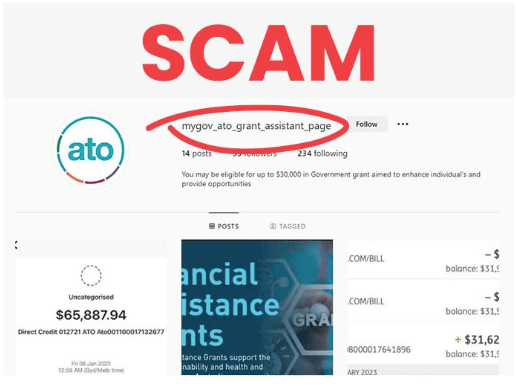
• The ATO’s official accounts are on Facebook, Twitter and LinkedIn. However, it will never initiate contact through these channels. It also has no presence on Instagram, so any ATO message there is guaranteed to be a phish.
• Be wary of suspicious ATO accounts. Legitimate profiles typically boast tens of thousands of followers and have been active for years. Steer clear of any new or low-follower accounts claiming to be the ATO.
• The ATO won’t send you an SMS or email with a link to log on to online services. These should be accessed directly by typing ato.gov.au or my.gov.au into your browser.
• While the ATO may use SMS or email to ask you to contact it, it will never ask you to return personal information through these channels.


3. Multifactor Authentication Phishing

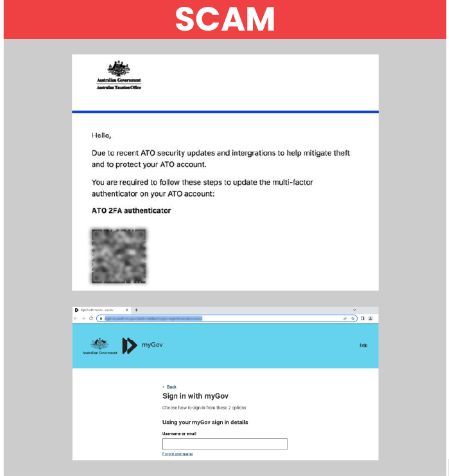
Be cautious of emails requesting an “MFA update” for your ATO account. Legitimate updates will never be communicated via email links or QR codes. The ATO prioritizes secure communication and will not send email or social media links directing you to log in to myGov or other online services. Access these services directly by typing ato.gov.au or my.gov.au into your browser.
How to spot a fake:
• The ATO will never ask you to update MFA via email, especially with a QR code, or a link to log in to online services. These codes typically lead to fake myGov login pages designed to steal your credentials.
• If you receive an email like this, do not scan the QR code, click on links, open attachments or download files. Forward the email to reportscams@ato.gov.au, and then delete it.

4. Tax Refund SMS Scams (Smishing)

Scammers exploit SMS messaging to trick individuals into clicking on links that lead to fake websites. Remember, the ATO will never send SMS with links for tax lodgments or refunds. If you receive suspicious SMS messages related to tax refunds, verify their authenticity through official channels.
Stay informed and cautious. If you encounter any suspicious communication claiming to be from the ATO, do not engage and report it immediately. For more detailed information on how to protect yourself from tax scams, visit the official ATO website.
Remember, your vigilance can prevent falling victim to these scams. Keep your personal information secure and verify any unexpected communication. Stay safe this tax season!

5. For all incoming communication from the ATO

1. If you receive an email, SMS, or phone call that says it is from the ATO, STOP and take a breath.
2. If it includes a link – IT IS A SCAM. Do not engage and report it.
3. If it includes an attachment (usually in an email) – IT IS A SCAM. Do not engage and report it.
Remember
1. The real ATO will never send you any links to click on.
2. If the real ATO does contact you, they will only ever ask you to contact them directly via their official sites, such as https://www.ato.gov.au or https://my.gov.au/, to log into your account.
3. Call the ATO if you are unsure or want to clarify something

Filed Under: Uncategorised Tagged With: Phishing, Scams, Tax scams

2025/26 Federal Budget: What It Means for You and Your Business

March 28, 2025 By raadmin

The 2025/26 Federal Budget brings a mix of tax cuts, business relief, and regulatory reforms aimed at easing cost-of-living pressures and strengthening Australia’s economy. Whether you’re an individual taxpayer or a small business owner, here’s a quick look at what matters most.

💰Tax Relief for Individuals

From 1 July 2026, the 16% tax rate on incomes between $18,201 and $45,000 will drop to 15%, then to 14% in 2027. That means tax savings of up to $268 in 2027 and $536 by 2028.

The Medicare levy threshold has also increased—single individuals earning under $27,222 won’t pay the levy at all in 2025, with higher limits for families and seniors. This brings welcomed relief, especially amid rising living costs.

🎓Student Debt and HELP Repayments

Student loan holders will benefit from a 20% debt reduction, pending legislation, on top of previous indexation reforms. Even better, the repayment threshold is increasing to $67,000 in 2026—allowing more time before repayments kick in.

⚡Energy Relief for Households and Small Businesses

Eligible households and small businesses will receive two $75 rebates off electricity bills through 2025, offering modest yet meaningful help in managing utility costs.

🏠 Housing Access and Affordability

The Help to Buy scheme is expanding, with income caps raised to $100,000 for individuals and $160,000 for joint applicants, and price caps linked to average state prices. This opens homeownership to more first-time buyers.

Meanwhile, a two-year ban on foreign purchases of established homes (starting April 2025) aims to boost housing availability for locals, alongside new compliance efforts to reduce land banking.

🚫Banning Non-Compete Clauses

To support worker mobility, non-compete clauses will be banned for those earning under $175,000. This includes actions to stop businesses from using “no-poach” and wage-fixing agreements—empowering employees and encouraging fairer labor practices.

🧾Support and Protection for Small Businesses

The Budget allocates $12 million over four years to support small businesses and franchisees. Key initiatives include:

  • Better enforcement of the Franchising Code of Conduct
  • Stronger action against illegal phoenixing, especially in construction
  • A new Social Enterprise Loan Fund for purpose-driven businesses
  • Exploring unfair trading protections for small business contracts

🍻Boosts for Hospitality and Alcohol Producers

Hospitality venues, brewers, distillers, and wine producers can breathe a little easier. The Government will pause draught beer excise indexation for two years (from August 2025) and increase the annual cap on excise and wine rebates to $400,000—a boost for local industry.

🕵️Cracking Down on Tax Avoidance and Scams

The ATO is getting nearly $1 billion over four years to expand its fight against the shadow economy, under-reported income, and large-scale tax avoidance. This ensures fairer competition and protects revenue.

Also, the National Anti-Scam Centre gets an extension to help protect consumers and businesses from rising scam threats.


Takeaway:

From individual tax cuts to small business protections and energy relief, the 2025/26 Budget is a multi-layered response to economic pressure and structural reform. Whether you’re filing a tax return, hiring staff, brewing beer, or buying a home—these changes could directly affect your financial decisions.

Need help understanding what it means for your specific situation? Please give us a call to make an appointment so we can help you understand it.

Filed Under: Uncategorised Tagged With: Federal Budget, small business, tax

Get ready for a minimum wage increase

June 24, 2024 By raadmin

In reference to the Annual Wage Review, the Fair Work Commission (FWC) have made the following announcements:

As of July 1, 2023, the National Minimum Wage will increase by 3.75%, effective from the first full pay period after 1 July 2024.

This adjustment sets the new National Minimum Wage at $915.90 per week, or $24.10 per hour.

Concurrently, minimum award wages will also see a 3.75% increase, impacting most employees who are covered by an award.

For those unsure about their applicable award, resources are available to assist in identifying the correct award.

These changes reflect the Commission’s commitment to maintaining equitable wage standards and supporting the workforce’s financial stability.

For more information about these measures click here.

Filed Under: Uncategorised

Classifying workers as employees or independent contractors

March 25, 2024 By raadmin

On February 9, 2022 the High Court handed down decisions, which have impacted the ATO’s advice and guidance in relation to classifying workers.

The Practical Compliance Guideline PCG 2023/2, initially presented as a draft under PCG 2022/D5, outlines the Australian Taxation Office’s (ATO) strategy for ensuring compliance among businesses involved in worker engagement and the distinction between employee and independent contractor classifications. This guideline sets out how the ATO allocates compliance resources, considering the associated risk related to worker classification.

This guideline will note how to determine whether a worker is an employee or an independent contractor. This is essential to guarantee that both the business and the worker can fulfill their obligations regarding tax, superannuation, ABN registration, and reporting.

The classification of a worker is established by the totality of the contractual arrangement between the involved parties, which includes any implied or verbal terms. The characterisation of their relationship relies on whether a worker is actively contributing to the engaging entity’s business, as opposed to operating an independent business of their own.

The guideline outlines the ATO’s risk framework concerning worker classification arrangements, which is derived from the actions taken by the involved parties when entering the arrangement. Parties have the option to conduct a self-assessment using this risk framework, providing them with an understanding of the likelihood of the ATO utilising compliance resources to examine their arrangement.

When the arrangement unmistakably falls under either employment or independent contracting, the parties may choose not to depend on the guideline. Instead, they can choose to self-assess based on their confidence in applying the correct classification.

The risk framework comprises of four zones: (A) very low risk, (b) low risk, (c) medium risk, and (d) high risk. In addition, the guideline specifies seven criteria that must be met for an arrangement to be categorised into one of these risk zones. The criteria relate to the parties’ arrangement, intention and understanding between the parties.

If there is a change in the operation of an arrangement between a worker and an engaging entity, a re-evaluation of their risk rating may be necessary. The guideline becomes applicable starting from December 6, 2023.

For more information about these measure click here.

Filed Under: Uncategorised

2023-24 Federal Budget Update

June 12, 2023 By raadmin

The 2023-24 Budget has been released by the Federal Government, presenting economic forecasts and highlighting key priorities such as providing relief for cost of living and promoting economic growth. 

The Treasurer has announced a set of measures aimed at alleviating the cost of living, which includes a package worth up to $3 billion for energy bill relief. This relief is anticipated to reduce the power bills by up to $500 for approximately five million households. Additionally, $1.3 billion has been allocated for home energy upgrades. These initiatives have been carefully designed to provide relief without contributing to inflationary pressures.  

In economic terms, the forecast predicts a Budget surplus of $4.2 billion for the year 2022-23. However, there is an anticipated underlying cash deficit of $13.9 billion for 2023-24 (and a project deficit of $35.1 billion for 2024-25). 

The expected economic growth for Australia is to slow down from 3.25% in 2022-23 to 1.5% in 2023-24, but it is expected to recover and reach 2.25% in 2024-25. 

Although inflation is currently high at 6% for the current year, it is expected to decrease to 3.25% in 2023-24 and subsequently return to the Reserve Bank of Australia’s target range of 2-3% in 2024-25. The Treasurer stated it is still higher than the preferred level for the Government. 

Here are some key highlights from this year’s Budget. 

Personal taxation Measures 

  • Stage 3 tax cuts – No changes to personal tax rates have been announced by the Government. As previously legislated, the Stage 3 personal income tax cuts will commence as of July 1, 2024. With these changes, the tax rate for the $45,000 to $200,000 tax bracket will be reduced from 32.5% to 30%. The 37% tax bracket will also be abolished on July 1, 2024. 
  • Medicare levy thresholds – For income years commencing from 2022/23 and onwards, the Medicare levy thresholds have been raised across all categories.  
  • Medicare levy exemption – From July 1, 2024, low-income taxpayers who meet the eligibility criteria for the current lump sum payment in arrears tax offset will have eligible lump sum payments exempted from the Medicare levy. This modification aims to provide relief for eligible individuals and ensure they are not subject to the Medicare levy on such payments.  

Small Business Measures 

  • Small business instant asset write-off threshold – Commencing July 1, 2023, to June 30, 2024, small businesses with an aggregated annual turnover of less than $10 million will benefit from a temporary threshold increase. The threshold will temporarily be increased to $20,000 for assets that are initially used or installed and ready for the use during this period. Assets valued at $20,000 or above can still be added to the small business simplified depreciation pool and depreciated at a rate of 15% in the first income year, followed by 30% each income year thereafter.  
  • Small business energy incentive – From July 1, 2023, to June 30, 2024, businesses with an annual turnover below $50 million will have the opportunity to receive an additional 20% deduction on expenditures aimed at promoting electrification and enhancing energy efficiency. To be eligible for this deduction, assets or upgrades must be put into service or installed ready for use within the specified timeframe.  
  • Small business lodgement penalty amnesty – Small businesses with a turnover less than $10 million, will be granted an amnesty that will waive penalties for failure to lodge outstanding tax statements that were initially due between July 1, 2023, to December 31, 2023, businesses will have the opportunity to lodge these outstanding tax statements without incurring any penalties.  
  • A lodgement penalty amnesty will be provided to small businesses with an aggregate turnover of less than $10 million. This amnesty aims to waive failure-to-lodge penalties for outstanding tax statements that were originally due between December 1, 2019, and February 29, 2022, and are lodged in the period from June 1, 2023 to December 31, 2023. 
  • PAYG & GST Instalment uplift factor – The Gross Domestic Product uplift factor will be adjusted to 6% instalments related to the 2023-24 income year (instead of 12% as would otherwise apply under the statutory formula). This change will be effective for instalments that become due after the measure is officially legislated.  

Business Taxation Measures  

  • Build to-rent properties – For eligible new build-to-rent projects, these changes will take effect where construction begins after 7:30pm (AEST) on May 9, 2023. The rate of the capital (depreciation) will be increased to 4% per year. Additionally, the final withholding tax rate on eligible fund payments from managed investment trust (MIT) investments will be reduced from 30% to 15%. 
  • FBT rules for electric vehicles – The Government has announced that as of April 1, 2025, plug-in hybrid electric vehicles will no longer be eligible for the Fringe Benefits Tax (FBT) exemption applicable to electric cars. 
  • Part IVA Extension – From July 1, 2024, the Government will broaden the application of the general anti-avoidance provisions in Part IVA of the Income Tax Assessment Act 1936 (ITAA 1936). These changes will address potential tax avoidance strategies relevant to foreign residents. 

Superannuation Measures 

  • Non-arm’s length income (NALI) – From July 1, 2023 there will be a change in the way non-arm’s length expenses (NALE) are taxed. The new change states that NALE taxed at 45%, known as NALI will limited to twice the amount of general expenses. This is reduction from the previous multiple of five. This change applies to Self-Managed Superannuation Funds (SMSFs) and small APRA fund. 
  • Super account balances above $3 million – Despite pushback from the industry the government has reaffirmed its plan to implement an additional 15% tax on superannuation balances exceeding $3 million starting as of July 1, 2025. This includes defined benefit schemes. No specific information about the changes has been provided, indicating the proposed adjustments will likely be implemented as previously announced. As a result, unrealised gains are anticipated to be subjected to the extra 15% tax.  
  • Payday super – Starting from July 1, 2026, employers will have the obligation to pay their employees’ super guarantee concurrently with their salary and wages.  
  • Regarding pension drawdowns, the Budget did not introduce any additional extension to the temporary reduction of the minimum annual payment amounts for superannuation pensions and annuities. The previous measure that implemented a 50% reduction in these minimum amounts is not extended beyond the 2023-24 financial year. 

For more information about these measures click here. 

Filed Under: Uncategorised

New Shutdown Rules For Awards

May 31, 2023 By raadmin

Fair Work Australia has advised that as of May 1, 2023, there are new rules regarding shutdowns in many awards.  

A business shutdown refers to the temporary closure, during festive periods such as Christmas and New Year. For additional information please refer to the Direction to take annual leave during shutdown.

Under the new regulations, the following conditions apply: 

  • Employees have the authority to mandate that employees use their paid annual leave during the temporary shutdown. 
  • Employers are obligated to provide written notice of the temporary shutdown period to all employees who are effected, allowing a minimum of 28 days’ notice. 
  • The requirement for employees to take annual leave must be reasonable.  
  • The notice period can be shortened if an agreement is reached between the employer and the majority of impacted employees 
  • If an employee lacks sufficient annual paid leave to cover the entire shutdown period, alternative arrangements can be through an agreement with the employer. These options include: 
  • Using accrued time off; 
  • Taking annual leave in advance, or; 
  • Opting for leave without pay 

During the shutdown period, if any public holidays coincide with the employee’s regular working days, the will receive compensation for those holidays. 

Who the changes apply to: 

These revised regulations are applicable to employers who fall under the scope of the affected awards. 

The Fair Work Australia website contains the updated details regarding the guidelines for taking annual leave during a shutdown. This information encompasses various industries and awards, such as: 

  • Building and construction 
  • Hair and beauty  
  • Hospitality (e.g. fast food and restaurants  
  • Real estate  

Access your industry via the Direction to take annual leave during shutdown webpage. 

Which awards are changing? 

The following list of award are changing: 

Use the 3-step Find my award tool to figure out what you are covered by. If you already know your award, you can access a copy directly from the List of awards page.  

For more information about these measures click here.

Filed Under: Uncategorised

Introducing Payday Super 

May 31, 2023 By raadmin


The Government plans to introducea reform mandating the payment of superannuation on payday, which it believes will have a positive impact on the retirement incomes of millions of Australians. 

As of July 1, 2026, employers will need to pay their employees’ super at the same time as they are paid. By doing so, they believe it will strengthen Australia’s superannuation system and enable a more dignified retirement for more workers in Australia. 

For example, if a 25-year-old, with a median income were to switch to payday super, while receiving both their super alongside their wages, they could be $6,000 or 1.5% better off than when they reach retirement age. 

It is claimed employers will experience a smoother payroll management with fewer accumulated liabilities on their records as a result of the more frequent super payments. 

It will not only simplify the process of monitoring and managing superannuation payments for employees but also enhance protection against potential exploitation by disreputable employers. 

According to the estimates of the Australian Taxation Office (ATO), approximately $3.4 billion worth of super went unpaid in years 2019-20, despite the majority of employers fulfilling their obligations.  

The Government has allocated additional resources to the ATO to further strengthen the system and help detect unpaid super payments at an early stage. Furthermore, the Government plans to establish higher targets for the ATO in terms of recovering outstanding superannuation payments. 

In the second half of 2023, the Treasury and the ATO will engage in close consultation with both industry representatives and stakeholders, regarding these proposed changes.  

With the start date being July 1, 2026, this will hopefully allow employers, superannuation funds, payroll providers, and other parts of the superannuation system time to adequately prepare for the implementation of the reform.  

For more information about these measures click here.  

Filed Under: Superannuation, Uncategorised

Super Contribution caps remain unchanged in 2023/24

March 27, 2023 By raadmin

The IFPA have announced that the government will keep Super contribution caps unchanged for the 2023/24 financial year.

Since the average weekly ordinary time earnings (AWOTE) figure for the December 2022 quarter was unable to meet the required threshold for indexing, the concessional cap will remain unchanged at $27,500 in 2023/23. As a result, the non-concessional contributions (NCC) cap for 2023/24 will also remain unchanged at $110,000, which is four times the concessional cap.

With the general transfer balance cap set to increase to $1.9 million on 1 July, 2023, this means the NCC bring forward the thresholds for 2023/24 are as follows:

Total super balance on 30 June 2023Maximum NCC capBring forward period 
Less than $1.68m$330,0003 years
$1.68m but less than $1.79m$220,0002 years
$1.79m but less than $1.9m$110,000Nil
$1.9m or moreNilNil

For more information about this measure click here.

Filed Under: Uncategorised

Working from home deductions 2022-23

March 22, 2023 By raadmin

There have been some new working from home deduction changes for 2022/23 and so the following is a summary of those changes. 

The pandemic has changed the way we work, with many people in Australia and around the world now working remotely from home. This has led to changes in tax deductions for expenses incurred while working from home. 

The proposed changes to the working from home fixed rate method has now been finalised and the ATO’s Practical Compliance Guide 2023/1 is now available. 

From the 2022/23 income year, the methods available to assist in calculating the work from home deductions include a revised fixed rate method and an actual cost method. 

The revised fixed rate method is an alternative method for calculating home office expenses. The revised fix rate method has been updated to make calculating expenses easier and avoid any time-consuming apportionment calculations. Therefore, creating better contemporary arrangements when working from home. 

Under this method, taxpayers can now claim an increased fixed rate of 67 cents per hour for home office expenses, regardless of the actual amount spent. The fixed rate calculates the claim for expenses such as electricity and gas. Individuals will no longer need to have a dedicated workspace, such as a home office, that is used exclusively for work purposes during the tax year.  

To claim the fixed rate method you must keep records of the hours worked from home, such as timesheets or diary entries. 

This also includes the evidence of all paid expenses you have incurred that are covered by the fixed rate method (such as phone or electricity bills). You must also have record of all the equipment you had bought in order to work from home, such as technology and/or furniture, which must also require the supplier, cost and date acquired.  

Taxpayers still have the option to use the actual cost method of claiming other work-related expenses as opposed to using the revised fixed rate method.   

For more information about these measures click here. 

Filed Under: Uncategorised

Instant Asset Write Off Deadline

March 22, 2023 By raadmin

A recent article written by Belinda Crowley, a tax principal at RSM Australia, has advised small businesses to act promptly in order to meet the deadline for the instant asset-write-off (IAW) scheme, otherwise, they may face significant bureaucratic hurdles once the stricter regulations are reinstated.

She stated that numerous small business and medium-sized enterprises (SMEs) would be caught off guard by the deadline and would be required to depreciate any asset worth over $1,000 after 30th June 2023.

This could be a significant time and financial burden, particularly for small businesses. Even if their accountants manage it on their behalf, it would still be an extra cost for them.

IAW has been a feature for small businesses since 2015. The government had introduced temporary full expensing as part of its support program for businesses of all sizes during the pandemic. These initiatives encourage business owners to invest in their enterprises. However, both schemes are now ending.

Accounting for occasional high-value assets of, say, $ 30,000, and doing the same for any asset valued over $1,000 (or $100 for larger businesses) created one of the most significant challenges. Crowley also suggested that SME’s that don’t require an asset write-off in the current financial year should save the depreciation for when it’s necessary.

Business owners must exercise caution and seek professional assistance before making a decision, if they are currently experiencing a challenging period and do not need the deduction to reduce their tax bill. It is also worth noting that supply chain disruptions mean that even if a business wants to buy an instant write-off asset, as the asset must be installed and ready for use before 30th June, 2023, or it will not be eligible to be claimed. Therefore, it is critical to be certain that the asset will be available and operational on the site before the 30th of June.

Although the government has announced initiatives such as the skills and training boost and technology investment boost, they are unlikely to have the same impact as the instant asset write-off.

SME’s should take advantage of the new 20% uplift deduction, which was highlighted a priority in the federal budget for areas such as environment, digitalization, and training. This deduction allows businesses to receive a $120 deduction for spending $100 on training or digitisation, with the incentive backdated to March 29, 2020. This benefit is very specific and only applicable to training conducted with registered training organizations, making it difficult for SME’s to access. Additionally, access to write-offs is limited to businesses with an aggregated turnover below $50 million, and the training boost expires on  June 30, 2024, while technology scheme only lasts until the end of this financial year. The uplift deduction would not be consistently beneficial across sectors, as some industries , such as agriculture, rely more on-the-job training than formal accredited courses.

If you need to discuss how you can utilize the IAW measures for your business please contact us. To read more detail about these measures please click here.

Filed Under: Tax, Uncategorised

  • « Previous Page
  • Page 1
  • Page 2
  • Page 3
  • Page 4
  • …
  • Page 8
  • Next Page »

Footer

Chartered Accountants

Follow us on social media:

  • Facebook
  • Twitter

Newsletter

Contact us:

  • 07 3367 0852
  • mail@raaccountants.com.au
  • 50 Musgrave Rd BRISBANE QLD 4059 PO Box 242 RED Hill QLD 4059
Tax Practitioners Board

Copyright © 2026 RA Business Advisors | Website by: Aktura Technology